

aluminium expo
8-10 July 2026
Hall N1-N5, Shanghai New International Expo Center

Recycled ALuminium Outlook: Demand Surge, Capacity Race, and the Policy Forces Shaping It All

Over the years now, global aluminium recycling market is on the upward trajectory, with recycled aluminium usage standing at 27.7 million tonnes in 2023 and 28.4 million tonnes in 2024, driven by the growing focus on sustainability and circular economy practices.  AL Circle’s comprehensive industry focus report, titled: “World Recycled ALuminium Market Analysis Industry Forecast to 2032”, highlights that by the end of 2032, the global aluminium recycling market size is poised to grow at a CAGR of 4.62 per cent from USD 107.05 billion in 2023 to USD 160.8 billion.

Demand forecast in line with usage

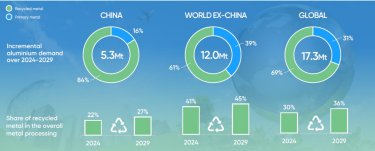
What is driving this growth? Certainly, the growing demand for recycled aluminium products. Rusal forecasts the incremental global demand for aluminium is set to reach 17.3 million tonnes by 2029, with recycled aluminium expected to contribute a substantial 69 per cent, compared to 31 per cent from primary aluminium.. In China, the dominance of secondary aluminium will be even stronger, accounting for 84 per cent of the projected 5.3 million tonnes of incremental demand. Overall, the share of recycled aluminium in total metal processing is expected to climb from 30 per cent in 2024 to 36 per cent by 2029.
And who is behind this demand growth?

Among all the end-user sectors that popularly consume recycled aluminium, automotive industry contributes the highest to the demand. Interestingly, it is the same sector that also generates maximum aluminium scrap and contributes significantly to recycling. Market survey suggests a discarded vehicle contains about 250 pounds of aluminium, of which 90 per cent is recovered for recycling. Each year, around 40 million end-of-life vehicles are processed, generating 5 million tonnes of aluminium scrap. Beverage cans are another major source of scrap. By the end of 2030, 630 billion aluminium cans are expected to recycle, generating 8.82 million tonnes of scrap.

Is recycling capacity on track to match the demand?

Over the past fourteen years, global secondary aluminium production has nearly doubled, growing from 21.33 million tonnes in 2010 to around 41.7 million tonnes in 2024. China has been the driving force each year, accounting for 39 per cent of the global secondary aluminium production in 2023 by churning out 15.744 million tonnes. That grew by 139 per cent from 6.585 million tonnes of output in 2010. Other Asian countries produced 7.1 million tonnes of secondary aluminium in 2023, followed by 5.939 million tonnes of output in Europe and 5.782 million tonnes in North America. Each of them contributed 17.5 per cent, 14.6 per cent, and 14.2 per cent, respectively, to the total global production.

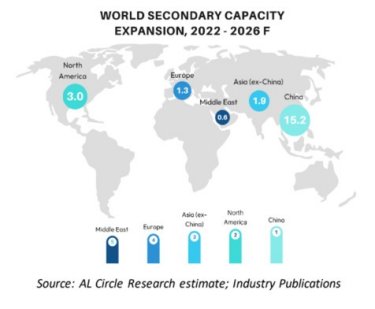
In terms of capacity, China leads the flock of major secondary aluminium-producing countries, with 11.5 million tonnes of annual ouput. By 2026, the capacity is expected to expand to 15.2 million tonnes with an addition of nearly 4 million tonnes. North America’s capacity is expected to grow to 3 million tonnes, followed by Asia (ex-China) to 1.9 million tonnes, Europe to 1.3 million tonnes, and the Middle East to 0.6 million tonnes.

Battle for safeguarding local resources to power homegrown capacity

Now, since almost all the major secondary aluminium-producing countries are mulling to scale up their domestic capacities, policy frameworks and trade strategies are increasingly being shaped to support this transition. The biggest example is the US President Donald Trump's import tariff policy that covers all the aluminium products, including primary aluminium, but strategically exclude scrap so that the country keeps securing the much-needed raw material for producing low-carbon or "green" aluminium.

Moreover, the country is also reportedly reducing its scrap supply. According to the data revealed by the US Geological Survey, the United States has decreased its scrap export volume from 1.04 million tonnes in H1 2024 to 1.03 million tonnes in H1 2025 – down by 1 per cent Y-o-Y.  This contraction occurs despite the rise in domestic scrap recovery through the first six months of 2025, from 1.76 million tonnes to 1.8 million tonnes, which reflects an impressive annual growth of 2.3 per cent.

The urge for safeguarding domestic aluminium scrap is also evident in the European Union. As the bloc aims to boost its recycling rate further from the present 90 per cent, it strives to curb the outflow of scrap from the domestic market, proposing a 30 per cent tariff on scrap exports. Although, in H1 2025, scrap exports from the EU have decreased Y-o-Yfrom  from 661,238 tonnes to 636,672 tonnes, yet the European Union is worried about "scrap leakage", given that it already touched a record volume of 1.26 million tonnes last year. Moreover, recyclers in the European Union have already invested EUR 700 million over the past decade and developed new furnaces, plant expansions, and process upgrades to boost recycling capacity by 1 million tonnes annually, yet15 per cent of recycling capacities remain idle today because of heavy exports.

So, it is evident now that nations are moving to safeguard their domestic aluminium scrap reserves to sustain local industries. The United States is already leading the charge as it is expecting a recycling capacity expansion to 3 million tonnes, while Western Europe expects its capacity to grow up to 1.3 million tonnes by 2026.

Source:AL Circle