aluminium expo
8-10 July 2026
Hall N1-N5, Shanghai New International Expo Center

Kautec’s Advanced Furnace Technologies for Sustainable Extrusion

Striving for a more sustainable aluminium industry, the company starts to rethink its furnace technologies with cutting-edge solutions for extrusion companies.

For decades, gas-fired furnaces have been the industry standard for heating aluminium billets prior to extrusion. Their widespread use is based on simplicity, power, and relatively low upfront costs. However, as extrusion plants face increasing pressure to reduce emissions, improve process control, and optimise energy consumption, traditional gas conduction furnaces reveal clear limitations.

In a conventional gas furnace, heat is transferred through conduction and convection using a system that combines a combustion zone and a recirculation zone of the exhausted gases. Burners placed along the furnace modules release flames, with a final zone incorporating a tapering system to ensure the temperature profile of the billet before extrusion. Precise temperature adjustment of the billet is essential to achieve an isothermal extrusion. Otherwise, the aluminium can melt in the die, forcing the extrusion press to reduce the extrusion velocity and affecting productivity.

At Kautec, it is believed that the future of extrusion begins by rethinking the very first step for certain product portfolios: how the billet is heated. Therefore, Kautec strives to design advanced solutions to match the evolving needs of different extrusion plants.

Transitioning from conventional to cutting-edge heating

As a first approach to this problem, Kautec proposes enhancing traditional systems rather than replacing gas entirely, by improving the thermal regulation of the tapering zone. The latest design introduces four annular heating zones with independent temperature control for each zone (see Figure 1), increasing the number of zones and the contact surface compared to conventional designs. This increase in the number of heating zones enables precise control over the temperature profile of the billet.
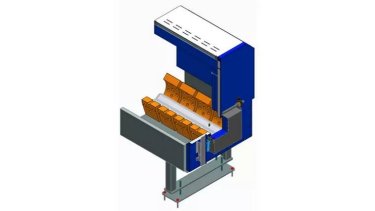
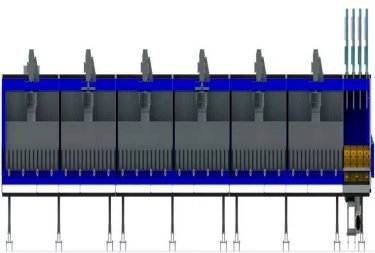
Figure 1: Kautec Annular heating zones

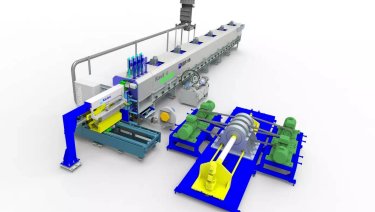
Kautec’s second proposal is to add electric resistors in the logs furnace. Following this proposal, the log is preheated up to 400ºC using electricity and, only at a limited final heating stage, gas is used to generate a precise taper to the billet via annular burners. This design, called the Kautec Hybrid Furnace (see Figure 2), significantly reduces gas consumption and the carbon footprint of the heating process. This solution integrates electric heating of the billet in the initial phase, uses gas burners only in a limited final phase, enables higher tapering capacity, allows a greater reduction of pollutants, and increases process efficiency. Moreover, this configuration ensures faster heating ramps, making it an ideal upgrade for plants seeking a greener footprint without sacrificing performance.

Figure 2: Kautec Hybrid Heating Furnace

Considering the fast evolution of technology and the market demand to extrude hard alloys, heating the billet by means of electromagnetic induction is crucial to achieve the mechanical requirements of the extruded profile. Instead of transferring heat to the billet using conduction or convection, an induction furnace generates heat within the billet by dissipating the induced electric currents via the Joule effect. This internal heating mechanism minimises heat losses and eliminates the need to transfer heat through the billet surface, increasing the efficiency of the heating process.

Moreover, it provides more controllability to the system, increasing accuracy in the achieved temperature profile of the billet and, consequently, increasing the tapering capability of the device. Finally, induction generates a quick response from the furnace, providing a higher heating velocity compared to conventional solutions.

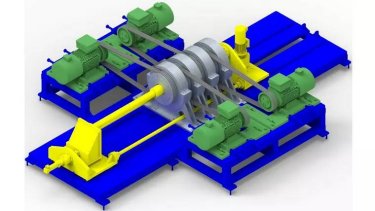
To properly adapt to the market's need for induction furnaces, Kautec’s third proposal is a Permanent Magnets Heater (see Figure 3). This furnace heats the billet by rotating magnetic rings with alternating polarities around the billet that induce electric currents on the billet’s surface. Unlike conventional induction heaters that use electric coils, our solution increases process efficiency by not generating heat at the primary source of the magnetic field. This is achieved by substituting the windings that form the electromagnets with SmCo permanent magnets that do not heat themselves. Moreover, no maintenance is required on the magnetic rings or the electric drives.

Figure 3: Kautec Permanent Magnets Heather

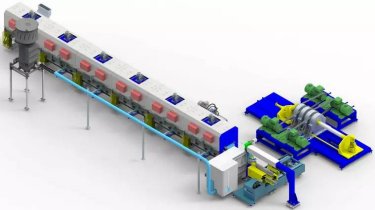
To provide a cost-effective heating process, Kautec proposes combining the Permanent Magnets Heater with a heater using electric resistors, resulting in the Kautec Zero Emission Furnace (see Figure 4). Following the same approach as in the Kautec Hybrid Furnace, we propose preheating the log up to 400ºC by blowing hot air heated by electric resistors. Then, to finalise the heating process of the billet, the induction heater is used. In this way, only one induction furnace is required for one extrusion line since the log is preheated and the induction heater is only used to precisely generate the required temperature profile on the billet before extrusion.

Moreover, the Kautec Zero Emission Furnace requires no gas and allows extrusion of aluminium profiles with a neutral carbon footprint. Finally, this combined solution offers overall efficiency exceeding 80%. Optionally, the permanent magnet can also be paired with a gas furnace, although this does not reach the same efficiency level.

Figure 4: Kautec Zero Emission Furnace

For tomorrow’s extrusion industry 

Kautec’s furnace innovations offer extrusion plants a tangible way to reduce gas dependency. Furthermore, they help achieve faster and more uniform heating, improve tapering control, and adapt the facility to future energy regulations. According to the company, the Kautec Hybrid and Kautec Zero Emission systems represent more than just a technological upgrade: They portray strategic tools for sustainability, flexibility, and long-term process optimisation.

In today’s aluminium extrusion industry, furnace technology plays a critical role in balancing productivity with environmental responsibility. Whether through high-efficiency hybrid models or cutting-edge magnetic systems, Kautec is committed to delivering solutions that redefine the possibilities in billet heating – smarter, cleaner, and more precise. By reducing gas dependency and emissions, improving temperature control, and enabling tighter tapering tolerances, these advanced furnace technologies are not just upgrades, but long-term investments in a more competitive and sustainable operation.

As global regulations tighten and energy costs rise, plants equipped with flexible, efficient, and emission-reducing systems will be better positioned to adapt and thrive. As Kautec proclaims, their innovations empower extrusion companies to meet today’s demands while preparing for the challenges of tomorrow. (ab)

Source:International Aluminium Journal